
2025-2026 Brief Regional Analysis
With so much happening on the global agenda, hereʼs a quick update on Latin America through a local, regional, and international lens — a concise look at the events impacting the countries of the region.

Regional Growth Overview
A Region in Motion
This brief outlines the key economic and business developments shaping Latin America in 2025–2026. It highlights why the region matters now and what to watch across macro trends, policy shifts, and market conditions. Several electoral processes are reshaping the political and investment landscape.
2025–2026 Outlook
LATAM shows diverse economic trajectories through 2026. While some nations face headwinds from US tariffs and global uncertainty, others demonstrate strong expansion driven by oil, commodities, and structural reforms. Regional growth is projected at 2.3% in 2025 and 2.1% in 2026. (KPMG/WorldBank)

Top Growth Champions
Guyana
2025: 19.3% | 2026f: 16.2%
Oil sector grew 21% in 2025; economy on track for sixth consecutive year of double-digit growth. ExxonMobil targeting 840,000 bpd in 2026.
Panama
2025-2026: ~3-4%
Logistics hub continues steady growth; canal operations and services sector remain key drivers.
Peru
2025: 3.2% | 2026f: 3.5%
Mining and commodity exports drive consistent expansion. Infrastructure investment and nearshoring interest add upside potential despite ongoing political uncertainty.
Bahamas
2025-2026: ~4-5%
Caribbean tourism recovery continues, though at a more moderate pace than the post-pandemic surge.
Major Economies: Mixed Signals
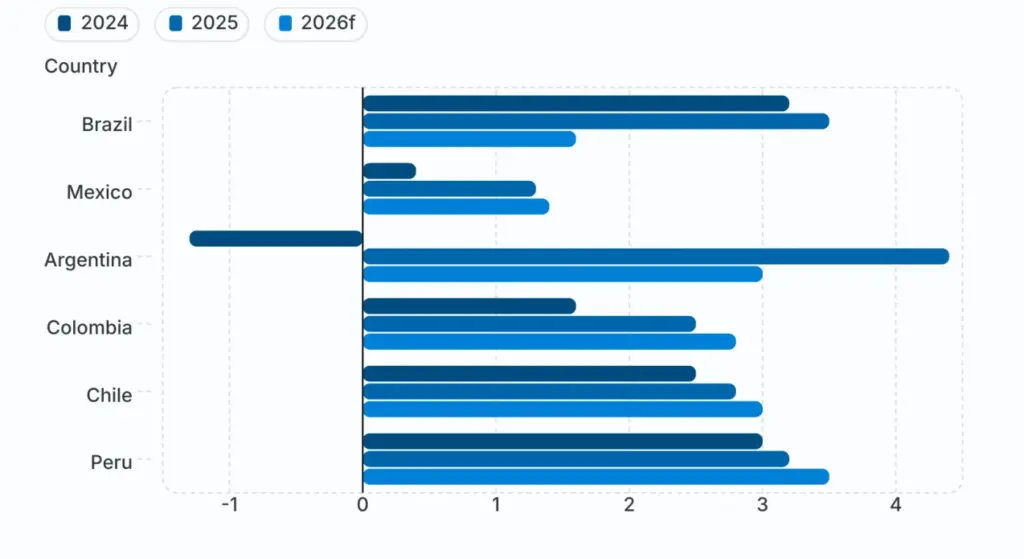
Brazil bounced back strongly in 2025 (+3.5%) but is expected to slow in 2026 as high interest rates bite.
Mexico is growing slowly — trade deal uncertainty with the US is keeping investors cautious.
Argentina is the region’s comeback story: Milei’s reforms drove a 4.4% rebound in 2025, with solid growth expected to continue.
Colombia is on a steady upward path due to hıgh consumption and government spending, though hight debt is worth watching.
Chile Copper-driven recovery gaining momentum. Structural reforms and lithium sector investment are positioning Chile as a key player in the global energy transition.
Peru Steady growth supported by mining exports and infrastructure investment, though political fragility remains a risk factor for investors to monitor.

Central America: Steady Performers
Costa Rica
Strong 4-5% growth. Tech sector and nearshoring drive diversified economy forward consistently.
Guatemala
Stable 3.7-3.9% expansion. Remittances and agriculture provide resilient foundation for growth.
El Salvador
Moderate 2.5-3.5% rates. Tourism and bitcoin adoption create unique economic positioning.
Key Drivers Behind Growth Patterns
Commodity Cycles
Oil, lithium, and copper remain critical to South America’s economy. However, softening commodity prices in 2025–2026 are compressing export revenues across the region. Chile stands out as a key exception — its copper and lithium reserves position it as a strategic supplier for the global energy transition, partially offsetting price headwinds. Guyana continues to outperform thanks to rapidly growing oil production.
Structural Reforms
Argentina’s Milei reforms delivered a confirmed 4.4% GDP rebound in 2025. Countries with fiscal discipline and business-friendly policies are outperforming regional averages.
Tourism Recovery
Caribbean tourism remains a key growth engine. The Bahamas and other island economies continue to benefit from sustained visitor flows, though growth is moderating from post-pandemic peaks.
Nearshoring Trend
US tariff uncertainty is a double-edged sword — it disrupts Mexico’s trade outlook but accelerates nearshoring investment in Central America. Costa Rica and Guatemala are key beneficiaries.

Countries Facing Headwinds
Bolivia
Contracts through 2027 (-1.5%). Political instability and commodity dependence create sustained pressure.
Haiti
Deep recession continues (-4.2% in 2026). Security and governance challenges hinder recovery efforts.
Jamaica
Negative growth 2026 (-0.5%). Debt burden and structural limitations constrain expansion potential.
Global Context & External Pressures
US Monetary Policy
Fed rate cuts are underway but gradual. Most LatAm central banks are also easing, though Brazil and Colombia remain exceptions. Capital flow pressures are easing but financing costs stay elevated for high-debt economies.
China Slowdown
Weak Chinese demand continues to weigh on commodity exporters. Falling commodity prices are dampening export revenue across South America, with more than half of LAC economies seeing downward growth revisions.
Geopolitical Tensions
US tariffs — 25% on Mexico (non-USMCA goods) and 10% on most other LatAm exports — are the region’s top external risk in 2026. USMCA renegotiation deadline of July 1, 2026 adds significant uncertainty for Mexico.
Iran Conflict: Emerging Risk for Latin America
Preliminary & Projected Impact — 2026
Oil Price Shock & Energy Costs
Strait of Hormuz disruption (20% of global oil) pushes energy prices up. Oil-importing nations face higher fuel and electricity costs, adding inflationary pressure. Brazil & Guyana could see short-term export benefits. Consider that Impacts are preliminary and evolving.
Fertilizer Supply Crisis
Iran is a major fertilizer exporter; ~41% of Brazil’s urea imports passed through Hormuz. Disruptions cause shortages and price spikes, threatening agricultural output across Brazil, Argentina, and Colombia.
Agricultural Trade Disruption
Iran was the largest buyer of Brazilian corn in 2025 (9.1M metric tons). The conflict disrupts trade flows and creates bottlenecks for grain/corn shipments to the Persian Gulf, hurting export revenues.
Inflation & Growth Downside Risk
Rising transport, energy, food, and fertilizer costs feed inflation. IMF projects LatAm growth at 2.2% in 2026 due to these pressures. Countries with high food import dependency are most exposed.

Technology & Future Opportunities in Mind
Digital Transformation
AI and automation reshape industries. Early adopters gain competitive advantages in productivity and innovation.
Energy Transition
Green investments accelerate regionally. Lithium, copper, and renewable resources create new growth engines.
Fintech Expansion
Financial inclusion increases access. Digital payments and banking democratize services across demographics.
Technological paradigm shifts create opportunities for leapfrogging development stages and building competitive advantages, ket Topics in Atlantika´s Business Portfolio.
Essential Insights for Business Leaders
01
Geographic Diversification
Businesses with exposure across multiple markets may be better positioned to navigate country-specific risk and uneven growth patterns.
02
Policy Change Awareness
Policy shifts and election cycles continue to shape business environments, influencing planning, regulation, and market confidence.
03
Nearshoring Opportunity
Supply chain relocations and regional trade agreements are creating new positioning opportunities for companies operating across borders.
04
Digital Adoption Trends
Digital tools continue to reshape efficiency, workflows, and competitiveness across evolving markets.
This analysis is intended for informational purposes and reflects current regional trends as of March 2026. This is not an investment advise
About Atlantika A.Ş.
Your Strategic Partner for Growth in Emerging Markets
Atlantika is a B2B strategy and innovation consultancy helping businesses navigate complex markets. We specialize in Strategy, Consulting, Business Development, Innovation & Technology, and Company AI Vision Support.
What We Do
Strategy & Consulting
Practical direction for complex growth decisions.
Business Development
Build partnerships, pipelines, and commercial momentum.
Innovation & Technology
Turn emerging tools into competitive advantage. See our Digital Hub
Company AI Vision Support
Shape an AI roadmap aligned with your business goals.
B2B Market Entry
Enter new markets with clarity and confidence.
Business Culture, Negotiation
Multicultural Team bringing local perspectives for global collaboration.
Let’s create the next chapter of your growth together.
Connect with us to explore opportunities in Turkiye, Spain, Latin America, and beyond.
Key Sources for you:
The insights in this report are grounded in leading global research and broad perspectives. Explore the primary sources below to dive deeper.
- Agenzia Fides — “The ambivalent effects of the war in Iran on Latin American countries” (March 27, 2026). fides.org
- Middle East Monitor — “Is Latin America paying the price for a war it had no say in?” (March 25, 2026). middleeastmonitor.com
- Latin America Reports — “What the halt in the Strait of Hormuz means for Latin America” (March 11, 2026). latinamericareports.com
- Callaway Climate Insights / Michael Molinski — “Iran war spreads to Latin America with commodities crunch” (March 25, 2026). callawayclimateinsights.com
- El País English — “How the war in Iran is affecting the main economies of Latin America” (March 4, 2026). english.elpais.com
- World Bank — “Global Economic Prospects” (January 2026). worldbank.org
- KPMG — “Latin America Economic Outlook 2025–2026”. kpmg.com
- IMF — “World Economic Outlook” (April 2025). imf.org
- ECLAC/CEPAL — “Economic Survey of Latin America and the Caribbean 2025”. cepal.org
- Inter-American Development Bank — “Latin American and Caribbean Macroeconomic Report 2025”. iadb.org
- Inter-American Development Bank — “Beyond Cash: The Digital Payments Revolution in Latin America and the Caribbean” (September 2025). iadb.org
- Inter-American Development Bank — “Resilience and Growth Prospects in a Shifting Global Economy: Latin American and Caribbean Macroeconomic Report” (March 2026). iadb.org